Which way up is Armenian?
Our page-orientation method leant on Latin letters carrying more ink above the line than below it. We measured whether Armenian letters do the same. They do not, and the measure that works for them does not work for English
You can raed this, even thuogh hlaf the wrods are wnorg. The trick went round by email in 2003 under the mock-medical name typoglycemia, and the claim that travelled with it, that only a word’s first and last letters matter, was overstated. But what it shows off is real, and psychologists have a drier name for it: the word superiority effect. A reader does not take in letters one at a time and assemble a word from them. The word arrives first, and the letters are checked against it afterwards, if at all.
Armenian readers do it too. When I was transcribing a page of the Tiflis Armenian newspaper Մշակ, I came across this oddity that is so easy to scan past as you read.
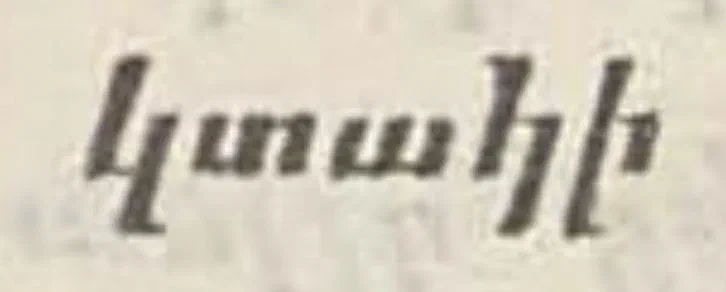
Take a look at the fourth letter … there’s something not quite right. What is that letter? If you think about it for a moment, you will realise that it’s the same as the first letter, but rotated 180 degrees.
This is something known as a turned sort and if you think about how printing used to be done, for each letter, the printer would take a piece of metal with a letter on one face (a sort) and insert it next to other letters to build up a page. And when a letter like կ is symmetrical, it’s quite easy to accidentally put it in rotated.
That’s a slightly long-winded way of introducing today’s topic. If one turned letter barely registers, then what is it that tells a reader that a whole page is upside down? If I show you a page of text that is upside down, I suspect it would take barely a moment for you to recognise that it is upside down. It certainly wouldn’t take much thought. Your eyes and brain are rapidly analysing statistical patterns across the page. But the statistical patterns a reader of English (well Latin really) text relies on may not be the ones that an Armenian reader sees.
Last week we described how the Empire on Trial ingest works out which pages of a microfilmed archive were filmed on their side, and which way to turn them. Two measurements, no training data: which way the lines of text run, and, for a page whose lines run down the image, which way is up. The second leant on a fact about Latin script, that ascenders, capitals, dots and bars put more ink above the body of a line than descenders put below it. We commented that we had not measured whether Armenian behaves the same way, and that for the archives Tetrak was built for this half of the method was something to test before applying the same rule everywhere. We have now tested it. This is what we found, including some problems with our original method that the Latin pages had hidden.
What we measured, and on what
The pages are the ones our Armenian recogniser is evaluated on: the held-out pages of eighteen printed works, 1840s to 1980s, Eastern and Western Armenian, in both the classical and the reformed orthography, from encyclopedia columns and a bilingual dictionary to literary prose and sixty pages of Mshak. Every page is known to be upright. There is no Armenian manuscript among them, because the project holds none, and that gap stands at the end of this article as it did at the start.
Alongside them, measured identically, two controls. Eighteen pages of Latin print from Tetrak’s own corpus, so that we could see whether the up-share, built on handwriting, survives typesetting at all. And the Empire on Trial frames themselves, the eighteenth-century hands the method was built on, so that any change we made to the method could be checked against the material it already worked on.
The procedure for every page was the same. Measure it as it is. Turn it through a half turn and measure again, recomputing everything from the rotated image rather than rotating the answer, so that the whole chain is tested for symmetry and not just the final number. The two readings must mirror: if an upright page scores two thirds, its half-turned copy must score one third. Turn it a quarter turn each way and measure the line direction. Then look at the spread of upright pages against the spread of turned ones, and ask whether a line can be drawn between them.
The up-share on Armenian
It cannot. Armenian print is remarkably symmetrical vertically. The share of a line’s outer ink lying above the line sits close to a half whichever way up the page is. Upright pages lean a little above a half and half-turned pages a little below, but the lean is a few hundredths where the Latin pages lean by a quarter, and the two distributions overlap broadly: a good many upright pages score below a half and a good many turned pages above it. Nor is the lean consistent. Most presses tilt slightly above when upright; Mshak, the largest single set, tilts the other way; one memoir comes out exactly level. There is no single direction to invert the rule for, which was the one escape the earlier article had left open.
The mirroring holds throughout, on every press, so this is not a flaw in the measurement. The measurement is symmetric and the script gives it nothing to measure. The one register that behaves differently confirms it: the Armenian–English dictionary, where every page is half Latin, scores where the Latin pages do.
The letter inventory says why, at least to the eye. Armenian lower case has a long list of letters that descend, including several of the most frequent (ր, ս, տ, ի, ւ, ց), and a long list that both ascend and descend (լ, խ, ծ, կ, հ, ձ, ղ, ճ, պ, ջ, փ, ք). Set text puts about as much ink below the body as above it, and which way the small residue leans depends on the face and on the words. The up-share is a fact about Latin letterforms, as the earlier article suspected, and not a fact about writing.
What the Latin pages had hidden
Two findings on the way concern the method rather than the script, and they are the reason the Empire on Trial ingest has changed this week even though its own verdicts have not.
The line finder was reading a tenth of a typeset page. On the manuscript pages the method was built on, a line of writing is a single hump in the row profile. On a typeset page it is a plateau: the x-height body is flat for ten rows or more, and its wobble reads as two or three local maxima a few rows apart. The finder merges maxima only when they are very close, and then requires a dip to half the peak’s height on each side of every line, so the maxima of one line reject each other in pairs. On one page a strip of the profile held a hundred candidate peaks and the finder accepted two. What survived was the handful of lines that happened to read as one hump, which is to say short lines, headings and folios, and the up-share was being computed on those.
Unfortunately, the article’s safeguard did not catch it. We had written that the upright and half-turned readings must mirror, and on these pages they did, closely. The finder was not biased towards one side of the line. It was biased towards a subset of the lines, and a mirror test cannot see that. What would have caught it is a count: how many lines the finder kept against how many it saw. The fix is one loop, merging adjacent maxima when the profile between them never drops below half the lower of the two, which is the same half-height criterion the finder already applies, used to decide that two maxima belong to one line. On the Empire on Trial reels it is harmless and slightly helpful: the sideways document’s vote tightened, and the one page that moved had sat on exactly a half. The ingest now also refuses to trust an up-share whose finder rejected more lines than it kept, and names the page in its report.
The two measurements want different resolutions. The earlier article settled on two thousand pixels along the long side, set by the smallest hand in the archive. That is right for the line-direction vote and wrong for the up-share on dense print, where the zone above and below a line’s body is a row or two at that scale and the asymmetry, where there is one, is lost in it. One Armenian face that showed nothing at two thousand pixels showed a clear lean at its native resolution. The reverse holds for the line direction: at native resolution the column profile starts to resolve individual letter strokes, the contrast between rows and columns shrinks, and a quarter of the Armenian pages fall into the unsure band that only one of them occupies at two thousand. Any port of the method should run the two measurements at different scales. It does not rescue the Armenian up-share, which was measured at native resolution for everything above.
The trained alternative
The earlier article set aside Tesseract’s orientation and script detection
mode, --psm 0, because it is a classifier trained on synthetic
renderings of printed scripts and our material was handwriting on
microfilm. Armenian print is nearer what it was trained on, so it was the
obvious thing to try next, and it is fast: well under a second a page.
We ran it over every page, as it is and turned three ways, with the Latin pages to establish which way round its answer is meant. On the Latin print it did well, as its training would predict. On the Armenian pages it was wrong far more often than right, and wrong in a particular way: it called most upright pages upside down and most upside-down pages upright, and it was more confident when wrong than when right, so a confidence threshold makes it worse rather than better. The explanation is in the script it reports, which is Latin, Arabic or Cyrillic and never Armenian, because Armenian is not among the scripts the detector was trained on. It is judging Armenian letters by how well they resemble the letters of other scripts in each of four orientations, and an Armenian page, it turns out, resembles Latin or Arabic print rather better when upside down. The one register it read perfectly was the bilingual dictionary, from the English half of each page. On the Empire on Trial manuscripts, which the earlier article had declined to trust it on, it was wrong on almost every frame and reported the hand as Japanese.
One could invert its Armenian answer and be right about four times in five. That would be leaning on an accident of a model trained for other scripts, which the next revision of its training data could remove without notice, and we would rather measure something.
Reading the shapes instead
Aradhye’s 2005 paper, which the earlier article named as where we would start, takes a different route. Rather than asking where the ink lies, it asks which way the open sides of the letters face, and it learns the useful direction for each script from samples of known orientation. We built the simplest version of that idea we could explain in a paragraph. Take each connected blob of ink that is about the size of a letter. Within it, find the background pixels that its own ink encloses on three sides and leaves open on the fourth: open upward, like the bowl of a u; open downward, like the arch of an n; open to the left or the right. Sum the areas over the page, and take the share that is open upward against open upward or downward. Turn the page through a half turn and up becomes down exactly, so the two readings mirror by construction.
On Armenian print this works. Upright pages have more of their concavities open upward, turned pages open downward, by a margin that separates them cleanly on every press, including Mshak. We tested it the way Aradhye prescribes, learning the direction from all the other presses and testing on the one held out, and every page of text came out right in every fold. The only pages it could not call were blank leaves and one dark frame, where it sat on a half and the line-direction vote had already reported nothing to measure, which is the right order to ask the questions in.
Then we ran the same measure on the Latin pages, and it was poor. On the Empire on Trial manuscripts it is no better than a coin, and on Latin print the direction depends on the face: the newspapers and the playbill lean one way and the typewritten technical report the other. Aradhye’s full method has more features than our one share and a classifier behind them, and we make no claim about it; our paragraph-sized version is a measure for Armenian print and not for English. The dictionary, half Armenian and half English on every page, came out the Latin way on this measure too, which is the failure a per-script rule has to expect from a bilingual page.
So the picture is the mirror image of where we started. The up-share reads Latin, in manuscript and in print, and reads nothing in Armenian. The concavity share reads Armenian print and reads nothing reliable in Latin. Neither is a measure of writing in a general sense; each is a measure of a specific script. The useful direction has to be learned per script, as Aradhye said, and so, it turns out, does the useful measure.
What this means for Tetrak
Three things, all of them simpler than the finding.
The line-direction vote, which does not care what the writing is, can be ported into the OCR pipeline as it stands, at the earlier article’s scale. It answers whether an Armenian page is on its side with the same margins it gave for English manuscript, with one bold-and-italic page in the unsure band.
The up-share should not be ported for Armenian pages. It would be right a little over half the time with no way to tell which half, and the per-document vote that rescues sparse manuscript pages cannot rescue a measure whose per-page errors are not a minority. It stays in the Empire on Trial ingest, for Latin, with this week’s two corrections.
For which way up an Armenian page is, the concavity share is the candidate, gated behind the line-direction vote so that blank leaves are reported rather than guessed at, and run only when the pipeline knows the page is Armenian. Tetrak does know: the Armenian recogniser is chosen explicitly, so the script is a fact the orientation step can be handed rather than one it has to infer. The pages measured here, with their half-turned copies, are the test set for it.
Further reading
- Hrishikesh B. Aradhye, “A generic method for determining up/down orientation of text in Roman and non-Roman scripts”, Pattern Recognition 38, 2005, pp. 2114–2131. doi:10.1016/j.patcog.2004.12.011. Orientation from which way the open sides of letter shapes face, with the useful direction learned per script from samples of known orientation. The concavity share above is the simplest reading of its central idea; the paper’s own method carries more features and a classifier.
- Robert S. Caprari, “Algorithm for text page up/down orientation determination”, Pattern Recognition Letters 21, 2000, pp. 311–317. doi:10.1016/S0167-8655(99)00161-0. Up from down by the ascender and descender asymmetry of the projection profile: the up-share this article measured, and found to be a property of Latin letterforms.
- Ranjith Unnikrishnan and Ray Smith, “Combined orientation and script
detection using the Tesseract OCR engine”, Proceedings of the
International Workshop on Multilingual OCR (MOCR ‘09), Barcelona,
2009, pp. 1–7.
doi:10.1145/1577802.1577809.
What
--psm 0does: a shape classifier trained on synthetic renderings of each script, scored over connected components in each of four orientations. The trained alternative tried above. - Wolfgang Postl, “Detection of linear oblique structures and skew scan in digitized documents”, Proceedings of the 8th International Conference on Pattern Recognition, 1986, pp. 687–689. The projection-profile method behind the line-direction vote, which this article found to be as script-agnostic as claimed.
- Tesseract documentation, Improving the quality of the output, which lists the page segmentation modes, including mode 0, orientation and script detection only.